


close
Choose Your Site
Global
Social Media


Views: 0 Author: Site Editor Publish Time: 2026-09-15 Origin: Site


Exporting lithium batteries involves incredibly high stakes. Missing or invalid compliance documentation routinely causes severe border rejections. It triggers massive shipping delays across the global supply chain. You might even lose lucrative B2B contracts over simple paperwork errors. Navigating these rules feels intimidating at first glance. However, knowing exactly what you need depends entirely on your specific situation. Your target market, transport method, and product format dictate the rules. Are you shipping standalone cells? Or are they integrated into complex equipment? Each path requires a different strategy. We set out to clarify this regulatory maze. This guide cuts through complex legal jargon entirely. It delivers an evidence-oriented approach to compliance planning. You will learn how to prioritize testing budgets efficiently. We show you how to manage testing timelines effectively. Understanding these mandates protects your supply chain. It also ensures you meet both legal and commercial buyer requirements smoothly.
Transport is the universal baseline: You cannot legally ship a lithium battery internationally without UN38.3 testing.
Market access dictates safety certs: CE certification is a legal minimum for the EU; UL certification is technically optional but commercially mandatory for major US buyers.
Cell vs. Pack requirements differ: Certifying the battery pack often requires that the internal cells already hold baseline certifications (like IEC 62133).
Time-to-market risk: Testing takes weeks to months; choosing accredited testing partners prevents costly re-tests.
Let us examine the operational realities of non-compliance. You risk seeing entire shipments impounded by customs agents immediately upon arrival. Aviation authorities heavily fine companies attempting to fly uncertified dangerous goods. Furthermore, non-compliance often voids commercial liability insurance instantly. If a catastrophic fire occurs during transit, your company faces total financial exposure. Securing valid lithium battery certifications prevents these disastrous scenarios.
We must differentiate clearly between legal requirements and commercial requirements. Governments enforce legal thresholds at their physical borders. Customs officials demand specific documents to clear cargo into a country. Meanwhile, commercial buyers demand vendor qualifications before signing purchase orders. Major retailers require safety marks to protect their own corporate liability. They audit vendors aggressively before issuing contracts.
Never ignore the hidden costs of cheap unaccredited testing labs. These budget options seem tempting initially. However, freight forwarders frequently reject their invalid reports. Major retailers refuse them completely. You end up paying twice for the exact same testing procedure while products sit idle in a warehouse. Selecting accredited labs from the start prevents these costly operational delays and protects your brand reputation.
We use a simple two-tiered framework. It clarifies your export compliance plan effectively. Manufacturers often confuse transport rules with consumer safety laws. Separating them saves time and prevents regulatory confusion.
First, you must address Tier 1. This represents battery shipping compliance. It focuses strictly on moving your product across international borders safely. You must satisfy stringent global rules for air, sea, and land transport. Regulators treat these power sources as hazardous materials during transit, regardless of their final destination.
Next, you tackle Tier 2. This represents product safety compliance for market access. Tier 2 ensures legal sale within the destination country. It also guarantees safe daily operation for the end user. You cannot achieve Tier 2 success without passing Tier 1 first. Transport always acts as the universal baseline for every manufacturer.
Global transport requires one absolute standard. You must secure UN38.3 testing. This UN standard evaluates batteries for extreme transport conditions. Regulators universally recognize it across all modes of freight.
Testing rigor includes several extreme physical evaluations. The standard involves eight specific tests (T1 through T8). They include thermal cycling tests simulating rapid temperature shifts in cargo holds. They feature high vibration tests mirroring severe turbulence. They also mandate physical shock tests replicating drops during pallet loading. Expect standard testing lead times to span two to four weeks depending on lab capacity.
Additionally, you must provide a UN38.3 Test Summary Report (TSR). Freight forwarders demand this specific document before loading any cargo. Without a valid TSR, your shipment remains grounded indefinitely. Airlines and maritime shipping lines maintain zero-tolerance policies regarding this documentation.
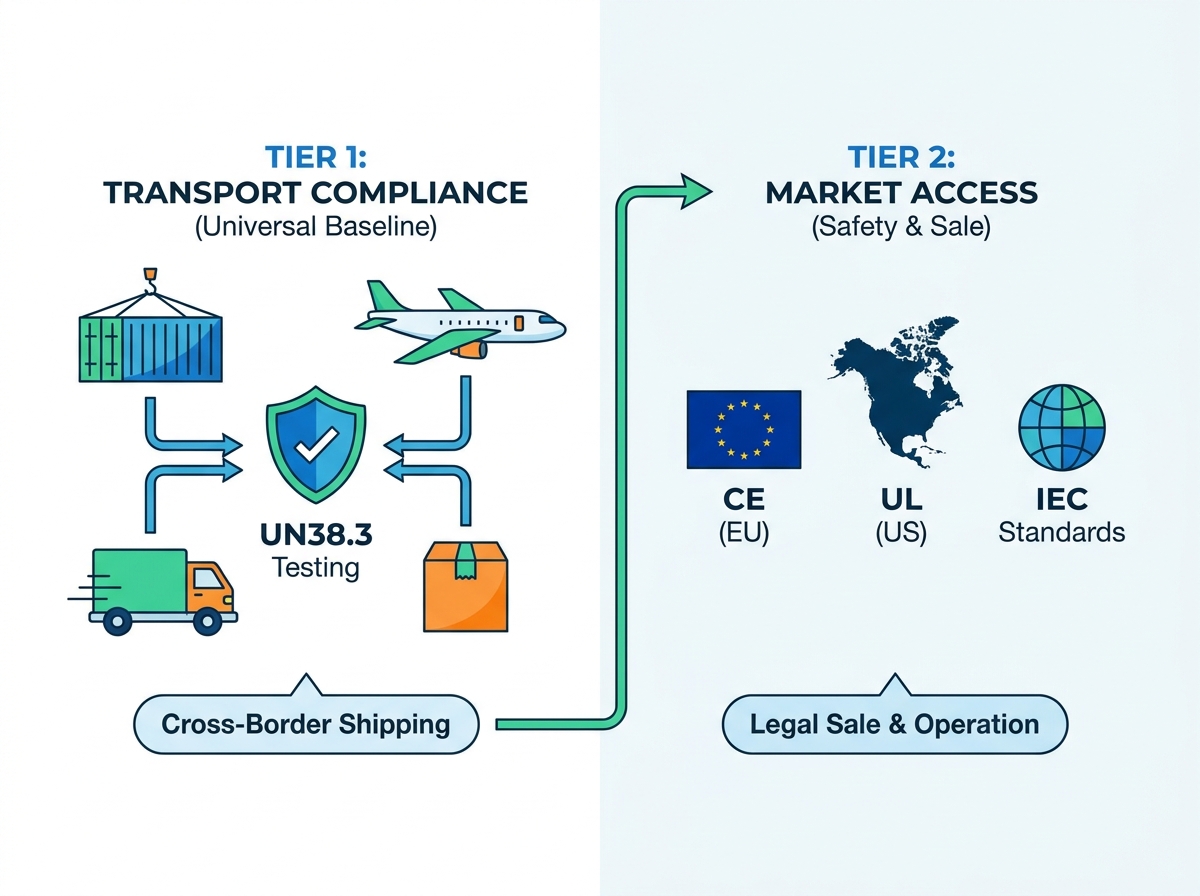
Reaching the destination border represents only half the battle. You must then clear specific market safety requirements. Different global markets demand varying evaluations. They focus heavily on safety features and operational outcomes under stress. We will outline the critical standards you need below.
North American markets prioritize rigorous consumer safety testing. You will frequently encounter UL certification here. For instance, UL 1642 governs individual lithium cells. Meanwhile, UL 2054 and UL 1973 apply to complete battery packs and energy storage systems. These tests often push products to failure to observe their safety mechanisms under single-fault conditions.
Technically, the US federal government considers UL a voluntary safety mark. However, it acts as a massive commercial gatekeeper. US retailers mandate it for physical shelf space. Original Equipment Manufacturers (OEMs) require it for critical vendor approval. Insurance underwriters often refuse commercial coverage without it. Skipping this step severely limits your B2B sales potential across North America.
Entering the European Union involves strict legal mandates. You must obtain CE certification before entering any EU member state. This process now heavily relies on the comprehensive new EU Battery Regulation. It also requires strict adherence to RoHS guidelines regarding hazardous substances.
To achieve CE compliance, you must pass specific fundamental tests. The standard IEC 62133 dictates rules for portable electronics. Conversely, IEC 62619 governs industrial applications and large energy storage systems. These testing pathways form the core backbone of European market entry. You cannot self-declare CE compliance without maintaining technical files proving you passed these exact standards.
Beyond North America and Europe, distinct regional thresholds exist globally. Japan enforces the strict PSE mark for consumer electronics. South Korea requires the KC certification for all imports. India relies heavily on BIS standards. Each of these represents a firm national threshold. Furthermore, they typically require localized lab testing within their respective countries. You cannot simply reuse European test reports for these specific Asian markets.
Product format changes the compliance landscape completely. We must address these implementation realities carefully. Shipping loose cells differs vastly from shipping a finished laptop or medical device.
Standalone (Bulk) Batteries: These face the highest transport scrutiny. The aviation industry designates them as PI965 (loose batteries). You must provide full individual cell and pack certifications. Regulators view bulk shipments as severe fire risks. They require distinct packaging labels and face stricter cargo aircraft limitations.
Batteries in Equipment: Integrated batteries require a different approach. They fall under PI967 (contained in equipment). They still absolutely require baseline transport testing. However, the final product certification dictates the ultimate safety mark. A medical device or a power tool dictates its own overarching standard.
Common Mistake: Designing custom packs with uncertified cells. Always use pre-certified cells in your designs. Securing pre-certified cells saves thousands of dollars during final product testing. It prevents redundant thermal and crush tests. It drastically shortens your time to market.
Budget constraints force tough choices on export teams. We provide a decision framework for manufacturers and B2B sellers. Prioritizing correctly prevents wasted capital and aligns your compliance budget with actual sales goals. Let us break this down into clear prioritization tiers.
Strategic Certification Prioritization Framework
Strategy Tier | Required Documents & Tests | Ideal Business Use Case |
|---|---|---|
The Bare Minimum | UN38.3 + SDS + Basic CE (EU only) | Low budget startups prioritizing high-speed market entry. |
The Premium Tier | CB Scheme + UL + Voluntary Quality Marks | Enterprise sales requiring high trust and premium margins. |
Risk factor warning: We strongly warn against over-certifying your products early. Avoid securing marks for markets you do not yet distribute in. This drains capital unnecessarily. Focus your testing budget exclusively on countries where you have confirmed purchase orders or immediate launch plans.
Choosing the right testing lab prevents major regulatory headaches. You must outline strict vendor evaluation criteria. This ensures entirely trustworthy results for customs officials and corporate buyers.
ISO/IEC 17025 Accreditation: Never use a lab lacking this vital credential. Customs agents look specifically for this accreditation on your reports. It proves the lab maintains strict quality management systems and utilizes calibrated equipment.
Global Recognition: Ensure the lab operates under the IECEE CB Scheme. This framework allows cross-certification seamlessly. You test the product once and gain acceptance almost everywhere. It eliminates duplicate regional testing and reduces overall costs significantly.
Next-step action: Request a preliminary review from your chosen lab. Do this before committing to full testing phases. It catches expensive design flaws early. Fixing a circuit board layout costs much less before official destructive testing begins.
Securing proper compliance documentation functions as a direct investment in market access. They are not merely regulatory taxes imposed by governments. Treating them as a strategic advantage accelerates your global expansion.
Start your compliance journey by securing transport approvals first. Select product safety standards based strictly on your 12-month target market roadmap. Prioritize your budget toward regions offering the highest return on investment. Always source pre-certified cells whenever possible to streamline your assembly and reduce final testing fees.
Do not navigate this complex landscape alone. Consult an accredited compliance expert today or download a detailed compliance checklist for your specific product category.
A: Yes. UN38.3 is a universal baseline. It applies to air, sea, and land transport. Maritime shipping lines enforce these regulations strictly under the IMDG Code. You cannot bypass this test by avoiding air freight.
A: No. The assembled pack must be tested independently. Even if the internal cells are certified, the welding, wiring, and Battery Management System (BMS) of the new pack alter its safety profile. It requires its own unique report.
A: IEC 62133 governs portable and consumer batteries, like those found in laptops and mobile phones. IEC 62619 applies to industrial applications and large energy storage systems. Your product's intended use dictates which standard applies.
A: Set realistic expectations. It often takes 8 to 12 weeks to complete the process. This timeline depends heavily on the laboratory's current capacity and whether your product passes all tests on the first attempt without design revisions.


