


close
Choose Your Site
Global
Social Media


Views: 0 Author: Site Editor Publish Time: 2026-11-09 Origin: Site


Commuters and fleet managers alike rely heavily on electric scooters for predictable, seamless transportation. Extended scooter downtime directly impacts daily commute reliability and disrupts broader fleet operations. We all hate waiting for a sluggish charge cycle to finish. Buyers evaluating replacement components or exploring faster charger upgrades consistently encounter a frustrating reality. There is a huge gap between idealized manufacturer charging claims and actual real-world performance. You plug it in expecting a quick boost, but the wait drags on endlessly. This guide demystifies the technical variables governing how fast an E Scooter Battery actually charges. We move beyond basic marketing metrics to examine battery management systems, capacity math, and hard electrical limits. You will gain the exact technical framework needed to safely evaluate aftermarket chargers or assess replacement packs without risking thermal damage or voiding warranties.
The Core Formula: Total charging time is primarily determined by battery capacity (Amp-hours) divided by charger output (Amps), plus a 15–20% buffer for efficiency loss.
BMS Throttling: Upgrading a charger does not guarantee faster speeds; the scooter’s Battery Management System acts as a hard limit to prevent overheating.
The 80/20 Rule: The final 20% of a charge cycle utilizes "trickle charging," which takes disproportionately longer than the first 80% to protect cell chemistry.
Hardware Matching: Replacing an Electric Scooter Battery Pack requires exact voltage alignment; mismatched chargers pose severe fire and degradation risks.
Understanding scooter charge times requires a basic grasp of two primary electrical variables. Think of your energy storage system as a fuel tank and your charger as the fuel pump. The interplay between these two components dictates your baseline charging speed.
Capacity (Ah): We measure the size of your "fuel tank" in Amp-hours. A 10Ah rating means it can theoretically deliver 10 amps of continuous current for exactly one hour. Larger numbers indicate a longer riding range.
Current (A): We measure the flow rate from the charger in Amps. A standard commuter charger typically outputs around 2A. This metric represents the maximum speed at which energy enters the system.
You can estimate your baseline turnaround time using simple division. The standard formula states: Capacity (Ah) divided by Charger Output (A) equals Base Time in hours. However, real physics rarely perfectly matches theoretical math.
We must introduce an inefficiency factor to establish trustworthy expectations. Electrical resistance inside the cells generates heat. This heat represents lost energy. Therefore, charging a 10Ah battery on a 2A charger does not take exactly five hours. You must add a 15% to 20% time buffer to account for thermal loss. In reality, this setup takes closer to six hours.
Battery Capacity (Ah) |
Charger Output (A) |
Theoretical Time (Hours) |
Realistic Time (+20% Buffer) |
|---|---|---|---|
7.5 Ah |
1.5 A |
5.0 hrs |
6.0 hrs |
10.0 Ah |
2.0 A |
5.0 hrs |
6.0 hrs |
15.0 Ah |
2.0 A |
7.5 hrs |
9.0 hrs |
20.0 Ah |
4.0 A (Dual 2A) |
5.0 hrs |
6.0 hrs |
Different rider profiles demand distinct hardware setups. A standard commuter configuration usually utilizes a 36V Lithium Scooter Battery. Manufacturers typically pair these with 1.5A to 2A chargers. This combination works perfectly for overnight charging. You park the scooter, plug it in, and wake up to full range.
High-performance models require a completely different approach. These beasts feature massive energy reserves, often exceeding 60V and 20Ah. Pushing energy into these massive packs through a single 2A charger could take 12 hours. To maintain practical turnaround times, high-end scooters utilize dual-port charging. They split the incoming current across multiple hardware pathways to safely accelerate the process.
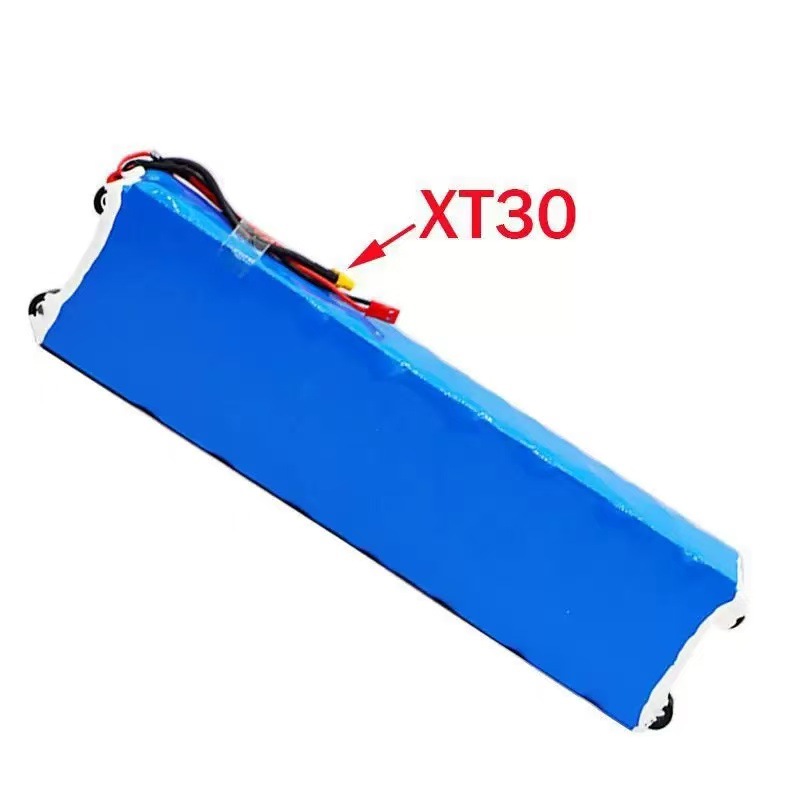
Many riders attempt to slash their wait times by simply purchasing a higher-amperage charger. They assume a 5A plug will automatically charge their scooter twice as fast as a 2A version. Unfortunately, electrical engineering sets rigid boundaries. Internal safety hardware frequently bottlenecks these aftermarket upgrades.
The Battery Management System acts as an uncompromising gatekeeper. This internal circuit board monitors temperature, voltage, and incoming current. It exists primarily to prevent catastrophic failures. If your manufacturer caps the BMS input limit at 3A, plugging in a 5A fast charger yields zero benefit. The BMS will instantly throttle the excess current. You merely waste money on an oversized charger while the BMS strictly regulates the flow.
Your charger does not push power at a constant speed from empty to full. Lithium-ion chemistry requires a delicate, two-phase charging profile.
Constant Current (CC): This represents the fast phase. From 0% up to roughly 80%, the charger pushes its maximum rated amps. The internal voltage steadily rises during this period. You gain range rapidly during this stage.
Constant Voltage (CV / Trickle Charge): This represents the slow phase. Once the pack reaches 80% capacity, the BMS intervenes. It holds the voltage steady and heavily restricts the incoming current. It carefully balances individual cell blocks to prevent dangerous overcharging. This final 20% often takes as long as the first 80%.
Your physical environment dictates actual charging performance. Extreme weather severely limits energy absorption. Charging a scooter in extreme heat (above 85°F/30°C) triggers thermal throttling. The BMS slows down or entirely halts the session to prevent permanent cell damage. Freezing temperatures pose an even greater threat. Charging cold lithium causes metallic plating, which destroys capacity instantly.
Cell aging also slows things down. Older packs inevitably develop higher internal resistance. They cannot accept incoming current as efficiently as fresh units. If your charge times suddenly increase significantly over a few weeks, internal resistance has likely spiked.
When daily downtime becomes unacceptable, riders naturally explore hardware upgrades. You must navigate this market carefully. The wrong purchase decision can ruin your investment or pose a severe fire hazard.
OEM Standard Chargers: These focus heavily on long-term safety and battery longevity. Manufacturers tune them conservatively to minimize heat generation.
Certified Fast Chargers: These focus on rapid turnaround. They offer higher amperage but maintain strict communication compatibility with the native BMS. They often cost significantly more.
Aftermarket/Third-Party Chargers: These appeal to budget-focused buyers. They carry incredibly high risks. Cheap internals often lack basic surge protection and thermal regulation.
Engineers evaluate charging speed using a metric called "C-Rate." This describes the charge or discharge rate relative to overall capacity. Charging a lithium-ion cell at higher than 0.5C (pushing half its total capacity in amps) generates immense friction. Pushing past this threshold accelerates chemical degradation. Fast charging inherently degrades total cycle life faster than standard charging.
Fast chargers offer tremendous advantages for gig workers. Delivery drivers need quick top-offs between shifts. A 4A charger cuts downtime significantly, keeping you on the road making money. Heavy commuters also appreciate the rapid turnaround.
However, you face strict compromises. Fast charging generates excess heat. Heat acts as the primary killer of lithium chemistry. Relying solely on fast chargers reduces your overall lifespan. You will experience fewer total charge cycles before needing a replacement. Furthermore, you risk overloading the internal wiring harness if your specific model does not officially support the higher amperage.
You should only purchase a fast charger under very specific conditions. First, verify the official technical specifications. Only proceed if the scooter's manufacturer explicitly lists the model as compatible. Check the maximum Amp input limits carefully. If the manual states a 3A limit, never buy a 4A or 5A charger. Strict adherence to manufacturer specifications remains the only way to avoid voiding your warranty.
Understanding the hardware represents only half the battle. Your daily habits dictate how long your components actually survive. Implementing disciplined charging routines prevents premature degradation and maximizes your financial investment.
Lithium-ion chemistry despises extremes. Sitting at 0% stresses the cells. Sitting at 100% also stresses the cells. The extremes of the voltage range cause the most chemical wear. We mitigate this through disciplined capacity management.
The 20-80% Rule: For typical daily use, avoid charging to 100% unless you need maximum range. Keeping the energy level between 20% and 80% dramatically reduces internal stress. This simple habit routinely maximizes the total lifespan of your Electric Scooter Battery Pack.
Cool Down Periods: Never plug in your scooter immediately after a long, aggressive ride. Discharging power generates significant heat. If you plug it in hot, the BMS will initiate thermal lockouts. Always allow at least 30 minutes for the cells to reach room temperature before applying a charge.
Storage Protocol: Proper winterization prevents catastrophic failures. If storing the scooter for several months, charge it to approximately 60%. Store it in a dry, temperature-controlled room. Check the voltage monthly. Allowing a lithium pack to deeply discharge to 0% during storage will permanently kill the cells.
Ultimately, charging time represents a fixed physical equation. It remains tightly constrained by pack size, charger output, and vital BMS safety limits. You cannot cheat the underlying chemistry. Standard charging takes time because it protects the delicate internal components from destructive heat.
Take actionable steps to manage your ride time effectively. Before you waste money on a faster charger, verify your scooter's maximum input amperage in the manual. Do not force excess current into a system designed for slow overnight cycles. Keep an eye on your baseline times. If your current charge times have doubled recently, the issue is likely cell degradation. This signals it is time to evaluate purchasing a certified replacement pack rather than searching for a magical new charger.
A: A standard commuter electric scooter typically takes 4 to 6 hours to charge fully. Manufacturers often cite faster theoretical times based purely on math. However, the real-world trickle charging phase slows the final 20% significantly. You must also account for thermal resistance and internal BMS throttling during daily use.
A: No. You must never use a higher voltage charger. Voltage must match your specific hardware exactly. For example, you need a 42V charger for a 36V system. Mismatched voltages bypass safety limits instantly. This error will destroy the internal cells and poses a severe fire hazard.
A: The final 10% utilizes the Constant Voltage (CV) phase. During this phase, the battery management system heavily restricts incoming current. It carefully balances individual cells. This trickle-charge method prevents dangerous overcharging and thermal runaway. Slower charging at the top end ultimately protects and preserves your cell chemistry.
A: A typical full charge requires less than one kilowatt-hour (kWh) of electricity. Even if a cycle takes six hours, the actual continuous power draw remains very low. Charging an average model costs just pennies per cycle. Despite the long wait times, daily charging remains highly economical.


